“Made For More” by Josh Baldwin is a worship song centered on the believer’s identity, redemption, and purpose in Christ. It speaks to the transformation that happens when someone moves from death to life—both spiritually and, for some, even physically. The song affirms that salvation is not the end, but the beginning of a life full of purpose, calling, and grace. It encourages listeners to reject shame, remember their forgiveness, and live with bold confidence in who God says they are.
This message resonates with people at every stage of faith. For the new believer, it offers assurance of being known, loved, and chosen. For the mature believer, it’s a powerful reminder to walk in the freedom and calling already given by God. It emphasizes that we are not meant to remain stuck in the past or live spiritually numb lives—we are meant to live fully in the truth and power of the gospel.
Key Bible Themes
- Identity in Christ
(Gal 2:20 ESV; 1 Jn 3:1 NIV) - Salvation as a beginning, not an end
(Phil 1:6 NLT) - Freedom and forgiveness
(Eph 1:7 CSB; Rom 8:1 ESV) - Calling and divine purpose
(Isa 43:1 NIV; Eph 2:10 NLT) - Spiritual resurrection and new life
(Rom 6:4 ESV; 2 Cor 5:17 NIV) - Grace overcoming shame
(Heb 4:16 NLT; Mic 7:19 ESV)
Verse
Verse 1 of “Made For More” begins with the words, “I know who I am / ’Cause I know who You are,” and that hits deeply for me. When I gave my life to Jesus at 16, everything changed—not overnight, but definitely for good. Before that moment, I was searching for identity in all the wrong places. But when I met Him, I realized that truly knowing who He is—the Savior, the Redeemer, the One who never lets go—revealed who I was meant to be. It reminds me of John 1:12, where it says we become children of God when we receive Him. That verse became real to me as a teenager trying to find where I belonged.
The next line, “The cross of salvation / Was only the start,” speaks directly to what I’ve experienced. That moment at 16 wasn’t just a one-time emotional high; it was the start of a lifelong journey. Like Philippians 1:6 says, He began a good work in me, and He’s still not done. In the 43 years since then, I’ve seen that the cross was the doorway, not the destination.
Then comes the lines, “Now I am chosen / Free and forgiven.” That still wrecks me in the best way. As a teen, I didn’t fully grasp it, but I knew something had lifted—shame, fear, guilt. And the older I get-the more valleys, and mountains-the more I understand what it means to be chosen, like it says in 1 Peter 2:9, and to walk in freedom and forgiveness like Ephesians 1:7 promises. These aren’t just lyrics to sing—they’re truths I’ve lived.
Finally, “I have a future / And it’s worth the living.” That line feels like it was written for me. The day I discovered that I needed a pacemaker, I blacked out three times over three hours. When I think about the possibility that I could have been driving on the Interstate, I’m overcome with gratitude. Now, every step has a purpose. Jeremiah 29:11 isn’t just a nice verse—it’s something I’ve clung to. And John 10:10, about life to the fullest, isn’t a vague idea. It’s the story of my life since I said yes to Him at 16.
Chorus
The chorus of “Made For More” speaks with power and urgency: “’Cause I wasn’t made to be tending a grave.” For me, that line brings to mind both literal and spiritual graves—both of which I’ve brushed up against more than once. The literal moments are unforgettable. I think of the time I was robbed at gunpoint-the barrel pressed against the back of my head. I felt the weight of what one split-second could’ve meant. Then there was the moment I learned I needed a pacemaker—my heart, the very thing keeping me alive, was failing. Either situation could have ended in a physical grave, yet God intervened. He preserved my life, not randomly, but intentionally. That alone tells me I’m here for a reason.
But there’s another kind of grave that can be even more dangerous: the spiritual one. Long before any bullets or heart monitors, there were seasons where I was alive on the outside but buried on the inside. Buried under shame, fear, regret, and lies about who I was. That’s the grave this song calls out. The lyrics “I was called by name / Born and raised / Back to life again” reflect not just being spared physically, but being resurrected spiritually.
So when the chorus asks, “Why would I make a bed in my shame / When a fountain of grace is running my way?” it’s not rhetorical—it’s real. I’ve seen too much. I’ve lived through too much to go back to spiritual death. Grace didn’t just visit me; it chased me down in moments I didn’t expect to survive. And now I can say with full confidence: “I know I am Yours / And I was made for more.” Can you? This isn’t just a lyric I sing—it’s the testimony I carry. I’ve walked out of graves, both physical and spiritual, and I’m still here for a reason.
Bridge
The bridge starts with a shout of victory: “Hallelujah / You called out my name.” That brings me back to the very beginning of my walk with God. I didn’t find Him—He found me. He called my name when I didn’t even know how to pray right. Just like Jesus called Lazarus out of the grave in John 11:43, He called me into life, and I’ve never been the same.
“So I’ll sing out Your praise” is more than just a lyric. It’s my response. After all He’s done, how could I stay silent? I owe Him everything. Psalm 40:3 says, “He put a new song in my mouth, a hymn of praise to our God.” That’s been my story ever since.
Then the final lines hit: “You buried my past / And I’m not going back.” That’s personal. There were things from my life before Christ—regrets, mistakes, lies I believed—that tried to follow me. But Jesus didn’t just forgive them; He buried them. Micah 7:19 says He hurls our sins into the depths of the sea. So why would I return to what He already buried? I’ve come too far to go back now.
Theological Depth
“Made For More” speaks on multiple levels, offering both spiritual milk for newer believers and spiritual meat for those who’ve walked with God longer. At the surface, it’s accessible and encouraging—centered around identity, forgiveness, and hope. These are foundational truths, or “milk,” that every believer needs to digest early in their walk. Lines like “I know who I am / ’Cause I know who You are” and “Now I am chosen / Free and forgiven” echo core gospel themes found throughout the New Testament, especially in Ephesians and Romans. These truths are nourishing to the young in faith, affirming that salvation brings not just rescue but purpose.
But beneath the surface, the song has deeper threads of spiritual meat—concepts that mature believers will recognize through lived experience. For example, “The cross of salvation was only the start” hints at sanctification and the ongoing nature of discipleship. It subtly points to Philippians 1:6, where Paul speaks of God completing the work He began in us. More seasoned believers will also resonate with the contrast of death and life, especially in the chorus, where phrases like “tending a grave” can be understood not just literally but spiritually—drawing on the language of Romans 6, which speaks of being dead to sin and alive in Christ.
That said, the song isn’t packed with direct biblical references. It leans more into thematic truth than explicit Scripture, which can be both a strength and a limitation. The imagery—graves, shame, fountains of grace—is emotionally powerful, but it depends on the listener’s biblical background to interpret those symbols through a theological lens. For someone without that grounding, the song may feel inspiring but vague. For a mature believer, however, the same lyrics may unlock a flood of scriptural connections and deeper reflection on their journey.
In that sense, “Made For More” functions like a parable—it’s simple enough to draw in anyone hungry for truth, yet rich enough that the seasoned can chew on it. It may not serve as a stand-alone teaching tool, but it opens the door to deeper conversation, testimony, and biblical exploration—especially when paired with personal stories of deliverance and grace. It invites every listener to consider where they’re living—near the grave or in the life Christ offers—and reminds them that no matter where they are in their walk, they were made for more.
Personal and Worship Team Experience
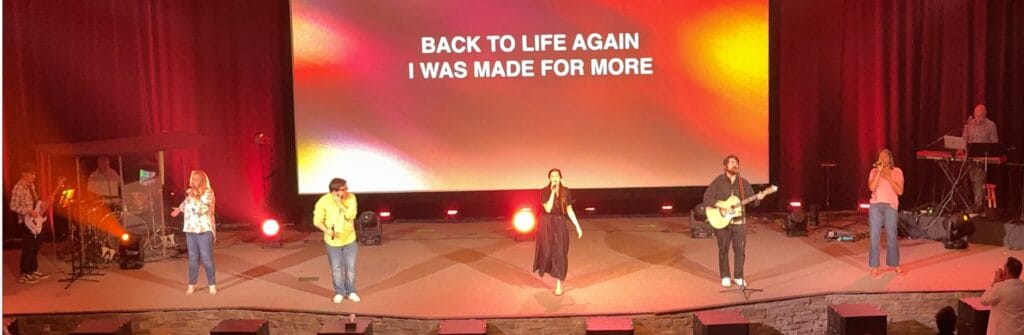
I recently got to experience the song on short notice. Our Baton Rouge campus needed a drummer and I was requested with just two days to prepare. I had not heard the song before, but I immediately connected. So much so that I wrote this song examination after listening to it fifteen times. It speaks to me, especially after launching My Story His Glory. It was another powerful reminder that God is able to do far more abundantly than all that we ask or think, according to the power at work within us (Ephesians 3:20).
Conclusion
At its core, “Made For More” is a powerful proclamation of biblical themes: identity in Christ (John 1:12), redemption and forgiveness (Ephesians 1:7), spiritual resurrection (Romans 6:4), and purpose beyond survival (Jeremiah 29:11). For worshipers, understanding these truths isn’t optional—it’s essential. If we’re going to lead others in declaring these lyrics, we must first let them take root in us. The song shouldn’t just be something we sing; it should be something we live. When team members can point to their own moments of being pulled from a grave—literal or spiritual—and say, “That line is my testimony,” the power of the song multiplies. It becomes more than music. It becomes ministry. And that’s what worship is ultimately about: not just sound, but transformation, starting with us.